William T. Cavanaugh

Professor of Philosophical Theology at DePaul University
Tuesday, September 24, 2024 @ 4:00 PM
Abstract
This lecture explores two sides of the modern economy: the rationalized and disenchanted world of the Amazon warehouse, and the enchanted world of products that magically appear on our doorsteps. Dr. Cavanaugh will argue that these are two sides of the same coin. First, he will show that even Max Weber himself could not shake free of the idea that modernity was haunted by enchantment in production. Second, he will look at Karl Marx’s analysis of enchantment in consumption. Finally, he will argue that the biblical concept of idolatry captures our current cultural moment: a shift in what we worship to things of our own creation.
Biography
William T. Cavanaugh, PhD from Duke University, is Professor of Catholic Studies and director for the Centre for World Catholicism and Intercultural Theology at DePaul University in Chicago. He is the author of The Myth of Religious Violence, Oxford University Press, 2009; and The Uses of Idols, Oxford University Press, 2024. His specialty is political theology, economic ethics, and ecclesiology. In his 2024 tome, Dr. Cavanaugh reveals his excellent scholarship in this deeply researched topic of cultural idolatry, offering a sustained, cogent, sympathetic critique in a wonderful model of public theology. This impressive work ranges across the fields of history, philosophy, political science, sociology, and cultural studies. For this lecture, special attention to chapters 3. and 7. will help.
See also https://www.firstthings.com/web-exclusives/2024/09/the-metaphysical-promise-of-the-consumer-society
“Idolatry is the human creation of systems that react back upon us and come to dominate us as false gods.” ~Bill Cavanaugh
Cavanaugh’s Research Interests
His major areas of research have to do with our encounter/engagement with social, political, and economic realities. He has authored six books and edited three more. His books and articles have been published in 10 languages. He has dealt with themes of the Church’s social and political presence in situations of violence and economic injustice. He just recently published a book on secularization and idolatry, called The Uses of Idolatry, exploring the ways in which a supposedly disenchanted Western society remains enchanted by nationalism, consumerism, and the cult of celebrity. He teaches in an interdisciplinary way, showing the riches and challenges of Christian tradition through art, theology, scripture, music, poetry, history, novels, etcetera.
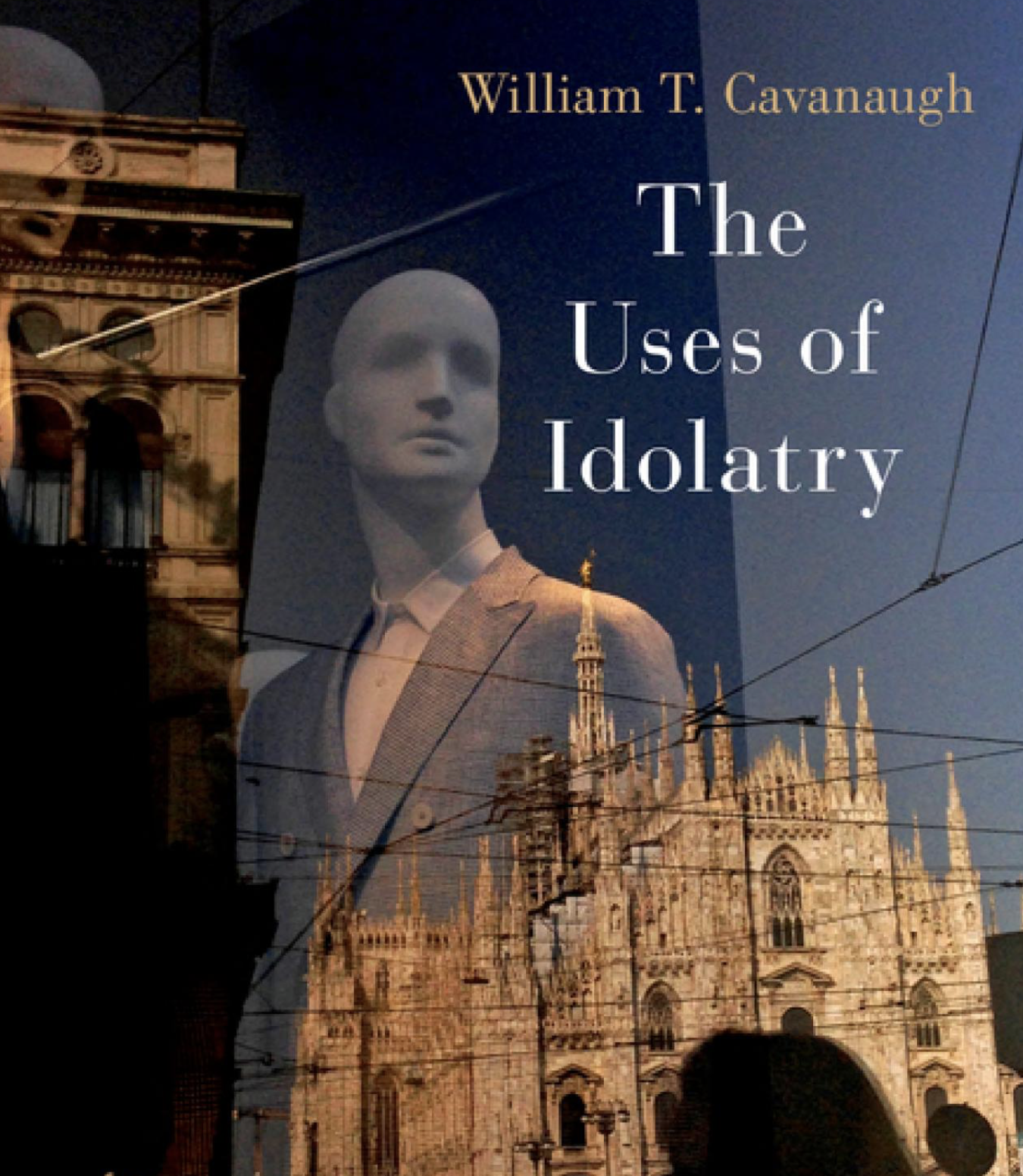
Jean-Luc Marion once described idolatry as the ‘low water mark of the divine.’ What he meant was: it is not something to be dismissed. Idolatry, too, is a sort of revelation. William Cavanaugh’s careful, sympathetic exercise in this important book embodies this approach. Akin to Augustine’s theologically inflected ethnography of the late Roman Empire, here Cavanaugh ‘reads’ the rituals of late capitalism in order to discern the devotions of our so-called secular age. But he does so in the spirit of invitation, not denunciation. A wonderful model of public theology written for a wide audience. (James K. A. Smith, author of How (Not) to Be Secular).
Book Review of The Uses of Idolatry
“The church is the incubator and the epicentre of counter-desire.” writes former GFCF lecturer Christopher Watkin in Biblical Critical Theory. (473-76) What are the rhythms of our hearts? The contrast below constitutes a veritable manifesto for an alternative outlook/lifestyle. Dr. Christopher Watkin contrasts consumption-desire and biblical intimacy-desire.
- Consumption-desire is centred in the consumer, who is always right and votes with the wallet. Intimacy-desire has two poles, the lover and the beloved, who both shape the relationship. Here freedom is defined by the ability to love and give life to one another.
- Consumption-desire is cyclical: lack, desire, consumption, satisfaction, dissatisfaction, repeat. Intimacy-desire forges a cumulative depth of relationship over time, investing over and over again continuously.
- Consumption-desire is fuelled by the noble lie of ultimate fulfilment–every product and pleasure contributes to the good life. Intimacy-desire is driven by the promise of ultimate fulfilment when “the kingdom of the world has become the kingdom of our Lord and his Messiah.” It seeks to fan into flame, develop and cultivate existing desires to meet the deepest human needs–it is servanthood-oriented or other-oriented.
- Consumption-desire is economic, obeying the laws of scarcity, equivalence, merit, and performance. It is motivated by debt. Intimacy-desire is aneconomic, running free in world of bounty, superabundance, gift, and grace. It is motivated by thankfulness and generosity. The principle is: the more I give away, the more I have.
- Consumption-desire is mediated by corporations who like monetizable assets like labour, money, our data. It is based on an investment of capital. It calculates and focuses on one’s use value. Intimacy-desire is unmediated: God and church do not want your monetizable assets; they want you, yourself as an end, a valuable image bearer, a member of a family. It is based on an investment of character and wants your full enjoyment/flourishing.
- Consumption-desire tends towards restlessness; Intimacy-desire tends towards rest.
- Consumption-desire understands pain as lack, to be remedied by further consumption. Intimacy-desire sees pain as growth, to be worked through and harnessed to deepen the relationship.
- Consumption-desire is indexed by possessions. Growth comes through accumulating more things, more money and assets. Intimacy-desire is indexed by dispossession–I lose my life in order to save it. My liberation/fulfilment is through self-forgetfulness, kindness, and generosity.
“The power and wisdom we desire, the love and freedom, the rest and satisfaction, the justice and fullness calls us forward…. The cross of Christ is the narrow road to the transfigured fullness of every human desire.” (Christopher Watkin, Biblical Critical Theory, 2022, 433)
Quotes from The Uses of Idolatry
“Circulation, not accumulation, is the point of a gift economy. Abundant life is not defined as possessing more things but as participating in the common good, the circulation of goods to all…. All goods belong to God, are inaugurated by God. What is needed is an economy based in gratuitousness and communion. We are recipients of God’s [superabundant generosity]. The most fulfilled people are those who communicate life to others. Jesus summons us to the revolution of tenderness. Going up against idolatry is fundamentally an act of thanksgiving for all the good gifts that God has lavished upon us. “ (William T. Cavanaugh, The Uses of Idolatry, 2024, 387)
“Our identity as consumers has become our primary—though not our only—identity. We are not primarily warriors or workers or prayers, but consumers, and we define who we are and who we aspire to be through consumption…. There is no benevolent and sovereign subject who becomes self-contradictory in a capitalist society; rather the human subject as such is self-contradictory, both altruistic and selfish, aware and unaware, rational and irrational. Freud connects consumerism with narcissism directly in his discussion of how parents shower their children with gifts as a way to satisfy their own narcissistic desires, while simultaneously thinking of themselves as altruistic…. Narcissism and idolatry are two sides of the same coin, and they lead to diminution of the self. True freedom is found in service to the Creator of that material world; a healthy engagement with the material world requires humility.” (W. T. Cavanaugh, 2024, 289, 327, 329)
2. November 7, 2024 @ 12:00 PM Denis Alexander. Finding God Through Dawkins: a Dramatic Irony
Abstract The so-called ‘New Atheism’ movement that came to prominence in the earlier part of this century has now declined. However, it has left in its wake an intriguing residue of religious and cultural consequences. One of the most prominent spokespersons for the movement has been Professor Richard Dawkins from Oxford University. The 2023 Kregel book, co-edited by Alister McGrath and Denis Alexander, Coming to Faith Through Dawkins, comprises twelve essays written by twelve different authors from five different countries and describes how the works of Dawkins and other New Atheist writers were influential in leading them from atheism or agnosticism to Christian faith. This lecture will review the roots of the New Atheism movement, and why it has led some former skeptics to Christian faith.
Biography Denis Alexander, a noted geneticist, biochemist, and cancer researcher is the Founding Director (Emeritus) of The Faraday Institute for Science and Religion, Cambridge, where he is Emeritus Fellow of St. Edmund’s College. He is past Chair of the Molecular Immunology Programme and Head of the Laboratory of Lymphocyte Signalling and Development at The Babraham Institute, Cambridge. Dr. Alexander’s latest books are: Is There Purpose in Biology? Oxford: Lion, 2018; and Are We Slaves to Our Genes? Cambridge University Press, 2020. He gave the 2012 Gifford Lectures at St. Andrew’s University.
3. Thursday, January 30, 2025 @ 4 PM Jeremy Begbie, Professor of Theology and Music, Duke University C. S. Lewis and Unfulfilled Longing: An Exploration through Music
Abstract C. S. Lewis famously spoke of fleeting experiences of joy he had early in life, a longing for something this world cannot satisfy. Dr. Begbie will creatively explore this through music, comparing this pre-Christian unfulfilled desire with Christian hope.
Biography Jeremy Begbie is the Thomas A. Langford Distinguished Research Professor of Theology at Duke Divinity School, and McDonald Agape Director of Duke Initiatives in Theology and the Arts. He teaches systematic theology, and specializes in the interface between theology and the arts. He is Senior Member at Wolfson College, Cambridge, and an Affiliated Lecturer in the Faculty of Music at the University of Cambridge. His books include Theology, Music and Time (Cambridge University Press); Resounding Truth: Christian Wisdom in the World of Music (Baker/SPCK); and Music, Modernity, and God (Oxford University Press); and Abundantly More (Baker). He is a very engaging speaker who has taught widely in the UK and North America, and delivered multimedia performance-lectures in many parts of the world.
4. Tuesday, March 4 @ 12:00 PM Quentin Genuis Rethinking Medical Ethics in Light of the Good.
Abstract What features define human life and the value of the individual? How do individuals and communities understand and withstand suffering and pain? What is good dying? In our time, the essential human questions are often viewed primarily as bioethics issues. In reality, these are not exclusively medical or bioethical inquiries. Rather they are complicated and challenging ethical questions with which all human beings and societies must grapple. How does Christian philosophy and theology inform these life and death questions at deeper, more foundational levels?
Biography Dr. Quentin Genuis MD is an Emergency Physician at St. Paul’s Hospital in Vancouver, and the Physician Ethicist for Providence Health Care. He holds a Master of Letters in Ethics from the University of St. Andrews, Scotland. He teaches in academic, clinical, professional, and lay settings on a variety of issues related to bioethics. His research and writing interests include the autonomy debates, end-of-life care, compassion, human dignity, addictions, and theological anthropology.
 UBC Graduate & Faculty Christian Forum